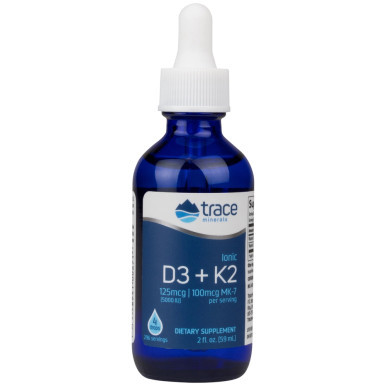
Vitamin D3 with K2 Liquid by Ortho Molecular Products – Bone Health and Immune Support Supplement
Vitamin D3 with K2 Liquid by Ortho Molecular Products delivers a highly absorbable pairing of vitamins that work together to promote strong bones, balanced calcium activity, and steady immune function. This convenient liquid format provides precise daily dosing, making it simple to maintain healthy vitamin D and K levels for whole-body wellness.
Key Vitamin D3 with K2 Liquid Benefits
- Supports bone strength, density, and long-term skeletal integrity
- Promotes healthy calcium absorption and utilization
- Encourages immune system readiness and overall vitality
- Helps maintain cardiovascular and arterial health
- Easy-to-take liquid D3 K2 drops for optimal daily support
How Vitamin D3 with K2 Liquid Works
This formula blends two synergistic nutrients essential for calcium balance and healthy bone metabolism. Both ingredients are well-tolerated and designed for safe, long-term use.
- Vitamin D3 (Cholecalciferol): Encourages efficient calcium absorption in the intestines while supporting immune function, mood balance, and muscular health.
- Vitamin K2 (MK-7): Directs calcium to bones and away from soft tissues, aiding proper mineralization and cardiovascular comfort.
Both nutrients are delivered in a stable liquid medium for steady absorption with minimal gastrointestinal effects and broad compatibility.
Vitamin D3 with K2 Liquid Is Formulated For
- Individuals seeking daily bone health support
- Adults wanting to maintain healthy vitamin D levels year-round
- Those looking to promote joint, bone, and skin wellness naturally
- Anyone preferring a clean, easy-to-measure liquid vitamin D3 K2 supplement
Supplements support your health but do not replace a balanced diet. Always check with your healthcare practitioner if you have doubts about a new supplement. Or you may book a FREE product consultation with Holistic Health Partners. You may want to look at our other Bone Health and Immune Support products.
Recommendation: Ortho Molecular Products suggests taking 1 or more drops of Liquid Vitamin D3 with K2 per day (can be taken directly on the tongue or mixed with the beverage of your choice) or as recommended by your health care professional.
Serving size: 1 drop (0.05 mL)
Servings per container: 590
Vitamin K2 (as Menaquinone-7 (MK-7)) 10 mcg
Does not contain: Wheat, gluten, dairy, fish, shellfish, peanuts, tree nuts, egg, artificial colors, sweeteners, or preservatives.
Cautions: If you are pregnant or nursing, do not consume this product.
These statements have not been evaluated by the FDA. This product is not intended to diagnose, treat, cure, or prevent any disease.
Click here to view Product Info Sheet
References:
- Schurgers, L. J., Spronk, H. M., Soute, B. A., Schiffers, P. M., DeMey, J. G., & Vermeer, C. (2007). Regression of warfarin-induced medial elastocalcinosis by high intake of vitamin K in rats. Blood, 109(7), 2823–2831. https://doi.org/10.1182/blood-2006-07-034403
- Weber, P. (1997). Management of osteoporosis: Is there a role for vitamin K? International Journal of Vitamin and Nutrition Research, 67(5), 350–356.
- Geleijnse, J. M., Vermeer, C., Grobbee, D. E., Schurgers, L. J., Knapen, M. H., van der Meer, I. M., Hofman, A., & Witteman, J. C. (2004). Dietary intake of menaquinone is associated with a reduced risk of coronary heart disease: The Rotterdam Study. The Journal of Nutrition, 134(11), 3100–3105. https://doi.org/10.1093/jn/134.11.3100
- Beulens, J. W., van der A, D. L., Grobbee, D. E., Sluijs, I., Spijkerman, A. M., & van der Schouw, Y. T. (2009). High dietary menaquinone intake is associated with reduced coronary calcification. Atherosclerosis, 203(2), 489–493. https://doi.org/10.1016/j.atherosclerosis.2008.07.010
- Kidd, P. M. (2010). Vitamins D and K as pleiotropic nutrients: Clinical importance to the skeletal and cardiovascular systems and preliminary evidence for synergy. Alternative Medicine Review, 15(3), 199–222.
- Plaza, S. M., & Lamson, D. W. (2005). Vitamin K2 in bone metabolism and osteoporosis. Alternative Medicine Review, 10(1), 24–35.
- Schurgers, L. J., Teunissen, K. J., Hamulyák, K., Knapen, M. H., Vik, H., & Vermeer, C. (2007). Vitamin K-containing dietary supplements: Comparison of synthetic vitamin K1 and natto-derived menaquinone. Blood, 109(8), 3279–3283. https://doi.org/10.1182/blood-2006-08-040709
- Shearer, M. J. (1992). Vitamin K metabolism and nutriture. Blood Reviews, 6(2), 92–104.
- University of Maryland Medical Center. (n.d.). Drugs that deplete vitamin K. Retrieved from http://umm.edu/health/medical/altmed/supplement-depletion-links/drugs-that-deplete-vitamin-k
- Kaneki, M., Hodges, S. J., Hosoi, T., Fujiwara, S., Lyons, A., Crean, S. J., Ishida, N., Nakagawa, M., Takechi, M., Sano, Y., Mizuno, Y., Hoshino, S., Miyao, M., Inoue, S., Horiki, K., Shiraki, M., Ouchi, Y., & Orimo, H. (2001). Japanese fermented soybean food as the major determinant of the large geographic difference in circulating levels of vitamin K2: Possible implications for hip-fracture risk. Nutrition, 17(4), 315–321. https://doi.org/10.1016/S0899-9007(00)00556-8
- Ushiroyama, T., Ikeda, A., & Ueki, M. (2002). Effect of continuous combined therapy with vitamin K2 and vitamin D3 on bone mineral density and coagulofibrinolysis function in postmenopausal women. Maturitas, 41(3), 211–221. https://doi.org/10.1016/S0378-5122(01)00292-0
- Beulens, J. W., van der A, D. L., Grobbee, D. E., Sluijs, I., Spijkerman, A. M., & van der Schouw, Y. T. (2010). Dietary phylloquinone and menaquinones intakes and risk of type 2 diabetes. Diabetes Care, 33(8), 1699–1705. https://doi.org/10.2337/dc10-0459
- Choi, H. J., Yu, J., Choi, H., An, J. H., Kim, S. W., Park, K. S., Jang, H. C., Kim, S. Y., & Shin, C. S. (2011). Vitamin K2 supplementation improves insulin sensitivity via osteocalcin metabolism: A placebo-controlled trial. Diabetes Care, 34(9), e147. https://doi.org/10.2337/dc11-0810
- Shea, M. K., Booth, S. L., Massaro, J. M., Jacques, P. F., D’Agostino, R. B. Sr., Dawson-Hughes, B., Ordovas, J. M., O’Donnell, C. J., Kathiresan, S., Keaney, J. F. Jr., Vasan, R. S., & Benjamin, E. J. (2008). Vitamin K and vitamin D status: Associations with inflammatory markers in the Framingham Offspring Study. American Journal of Epidemiology, 167(3), 313–320. https://doi.org/10.1093/aje/kwm306
- Iijima, H., Shinzaki, S., & Takehara, T. (2012). The importance of vitamins D and K for bone health and immune function in inflammatory bowel disease. Current Opinion in Clinical Nutrition and Metabolic Care, 15(6), 635–640. https://doi.org/10.1097/MCO.0b013e328358d8fb
- Checker, R., Sharma, D., Sandur, S. K., Khan, N. M., Patwardhan, R. S., Kohli, V., & Sainis, K. B. (2011). Vitamin K3 suppressed inflammatory and immune responses in a redox-dependent manner. Free Radical Research, 45(8), 975–985. https://doi.org/10.3109/10715762.2011.574576